The Art of Audible Time
The history, mechanics, acoustics and collecting significance of the minute repeater, with three documented auction results.
Download the Journal · PDF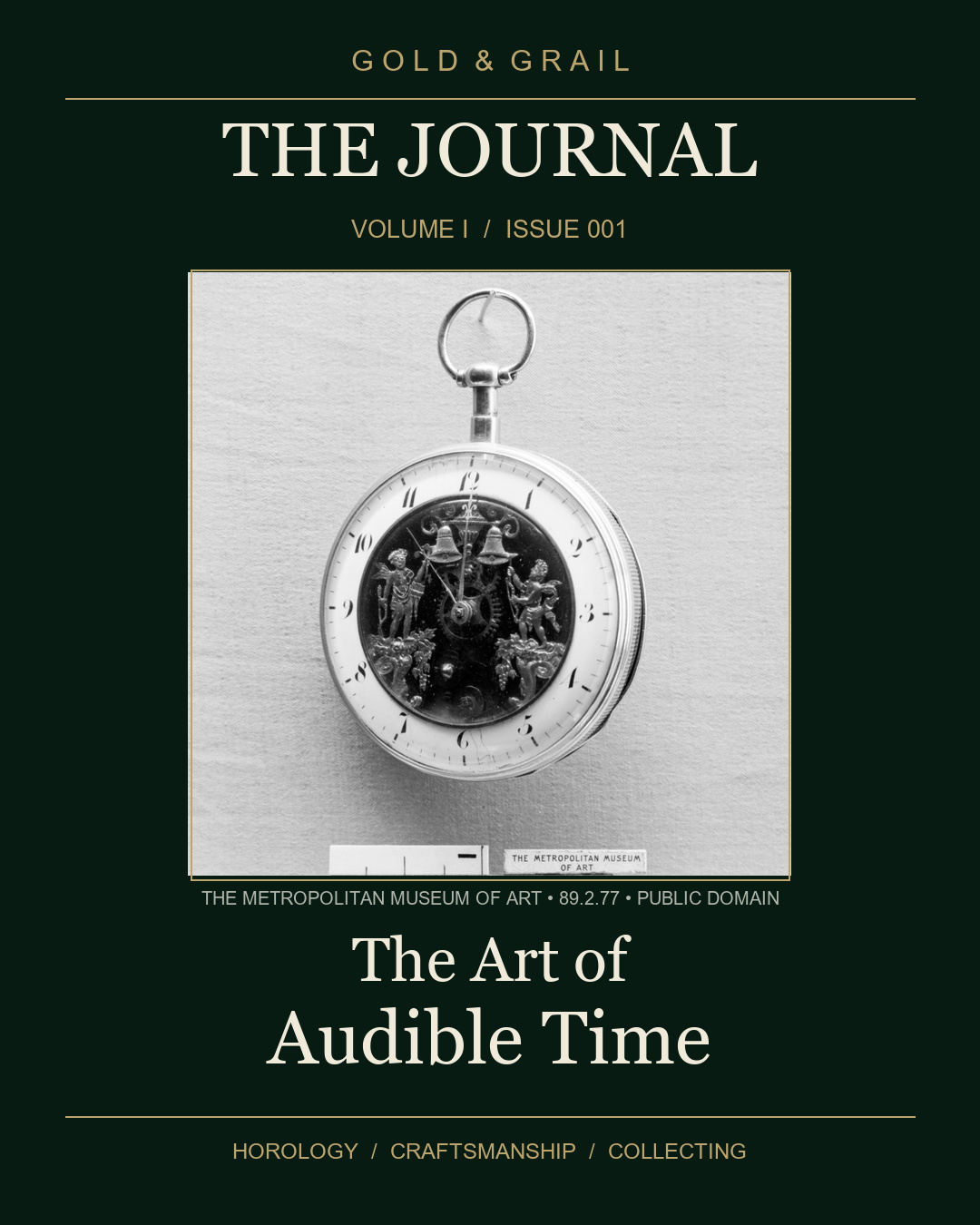
Imagine standing in a room after the candles have gone out. The face of your watch disappears, but the time is still there. You move a small lever across the case, and the object in your hand begins to speak: first in a deep register, then in pairs of notes, and finally in a higher register. The sounds are not a melody. They are a number, translated into a language that requires no light.
A repeating watch belongs to a remarkable class of machines that make the invisible perceptible. Its importance is not simply that a mechanical object can produce a sound. It must interrogate the position of its own timekeeping mechanism, translate that information into discrete units and execute a sequence of strikes with sufficient consistency to make the result intelligible. In a very small enclosure, the watch becomes both a clock and an instrument.
Before the dial could be read
Audible timekeeping long preceded the wristwatch. Public clocks could communicate the passage of time without requiring a person to see their dials; repeaters brought an on-demand version of that idea into a portable object. In an age when nighttime illumination was far less convenient, the ability to ascertain the hour without reading a dial was useful in its own right. Modern collectors experience that function under very different circumstances, but the underlying ingenuity remains.
The Patek Philippe Museum's historical catalogue places the development of repeating watches in the late seventeenth century. It attributes an early hour-and-quarter mechanism to Daniel Quare, around 1680, and associates Thomas Mudge with minute repeating around 1750. Abraham-Louis Breguet later helped replace bulky bell arrangements with compact wire gongs, changing how striking mechanisms could be housed. These are milestones in an evolving tradition rather than proof that any single inventor independently created every feature of the modern repeater.
Not every repeater communicates the same information. Quarter repeaters express the hour and elapsed quarter-hours; other historical versions subdivide the quarter differently. A minute repeater adds individual minutes, enabling a much more precise reading. It is important not to infer the type of repeater solely from the presence of a slide, an interesting case or an auction title.
How a watch learns to speak
In a typical mechanical minute repeater, the slide supplies energy to the striking mechanism. Internally, shaped cams, often called snails, represent the time in different increments. Toothed racks interact with those profiles to determine how far they can travel, and therefore how many strikes should follow. The exact architecture varies by caliber; the underlying problem is to convert continuous hand positions into a count of hours, quarters and residual minutes.
Small hammers strike tuned gongs mounted within the case. A regulator controls the pace of the striking sequence. A common arrangement uses a deeper tone for each completed hour, a two-note pattern for each completed quarter-hour, and a higher tone for each remaining minute. The sound must remain sufficiently distinct for a listener to decode the sequence. The striking train is not merely an audible extension of the hands: it is another mechanical system that has to be coordinated with them.
Reading 10:38 by ear
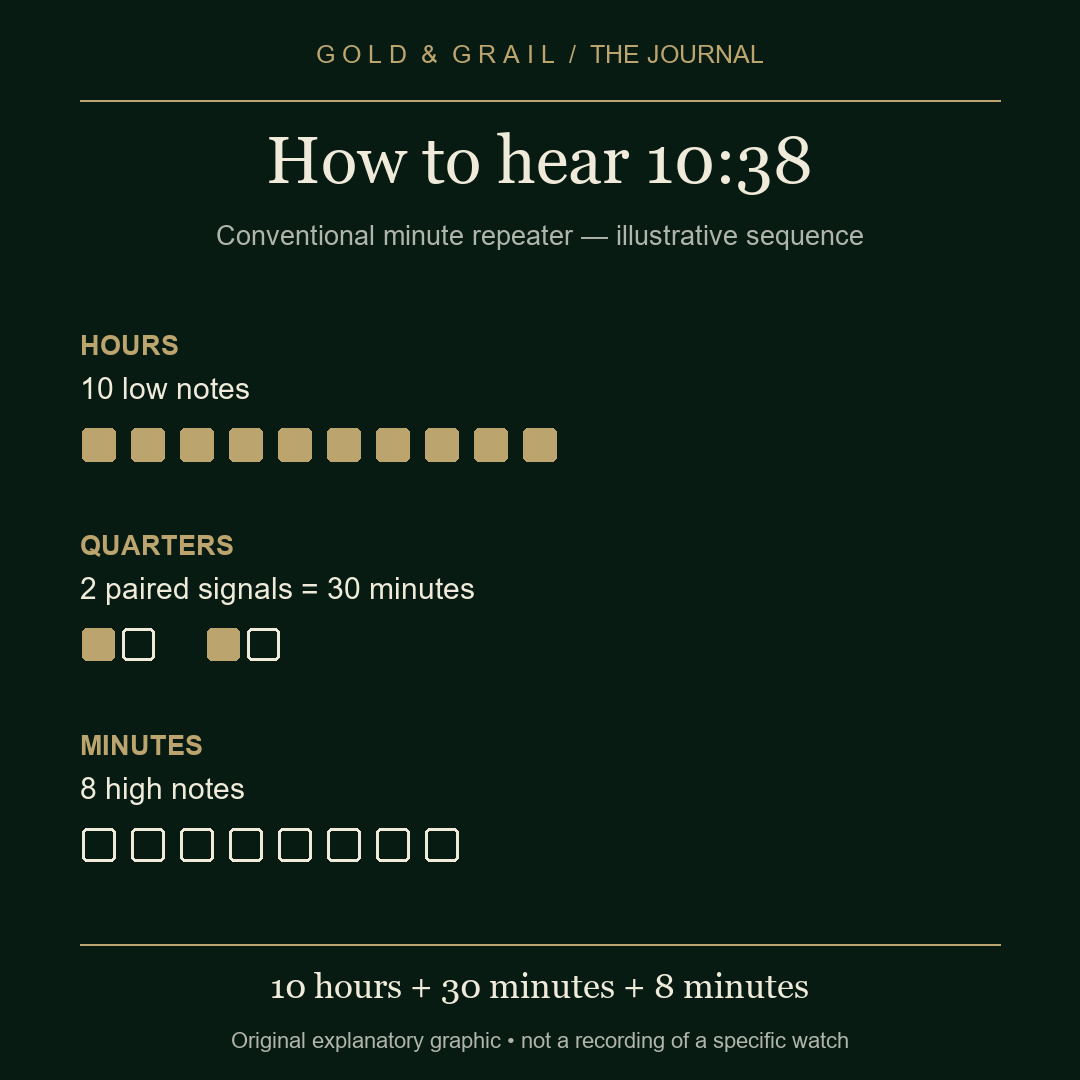
Ten hour strikes + two quarter-hour pairs + eight minute strikes = 22 hammer impacts.
At 10:38, the striking train delivers ten low-pitched hour strikes, two alternating double strikes for the elapsed quarter-hours, and eight high-pitched minute strikes. The resulting 22 hammer impacts communicate the time to the minute. Although this striking convention is characteristic of the traditional two-gong minute repeater, the tonal character, cadence and resonance remain distinctive to the individual caliber and its acoustic construction.
Repeaters should also be distinguished from sonneries. A repeater sounds when activated. A grande or petite sonnerie strikes automatically according to its particular complication architecture; some watches combine automatic striking with an on-demand repeating function. A striking watch, an alarm and a minute repeater should not be treated as interchangeable terms.
The sound of the case
A gong cannot be judged in isolation from the object that contains it. The energy of the hammer's impact, the shape and attachment of the gong, the available space and the case's acoustic behavior all influence what reaches the listener. Sound quality is consequently a system-level characteristic rather than a direct proxy for the value of the case metal.
Patek Philippe describes traditional steel-wire gongs and longer cathedral gongs, the latter introduced in its own collection in 2000. Longer gongs can produce a different resonance, but a label such as cathedral does not establish that a particular watch is acoustically superior. A listener should consider clarity, separation between notes, rhythm, unwanted mechanical noise and whether the sequence can be understood.
Online recordings introduce another variable. Microphone distance, room reflections, compression, noise reduction and gain can substantially affect the apparent quality of a chime. Two recordings made in different environments are not a controlled comparison. For an editorial encounter with a repeater, the most meaningful approach is to preserve the natural sound, identify the object accurately and explain how the recording was made.
An object from the archive
The Metropolitan Museum of Art preserves an early nineteenth-century Swiss repeater pocket watch associated with La Chaux-de-Fonds, accession 89.2.77. Its case incorporates gold, silver and enamel, with a diameter of approximately 5.4 centimeters. The object entered the museum through the gift of Joseph W. Drexel in 1889. The record offers a tangible connection to the historical culture of portable audible timekeeping.
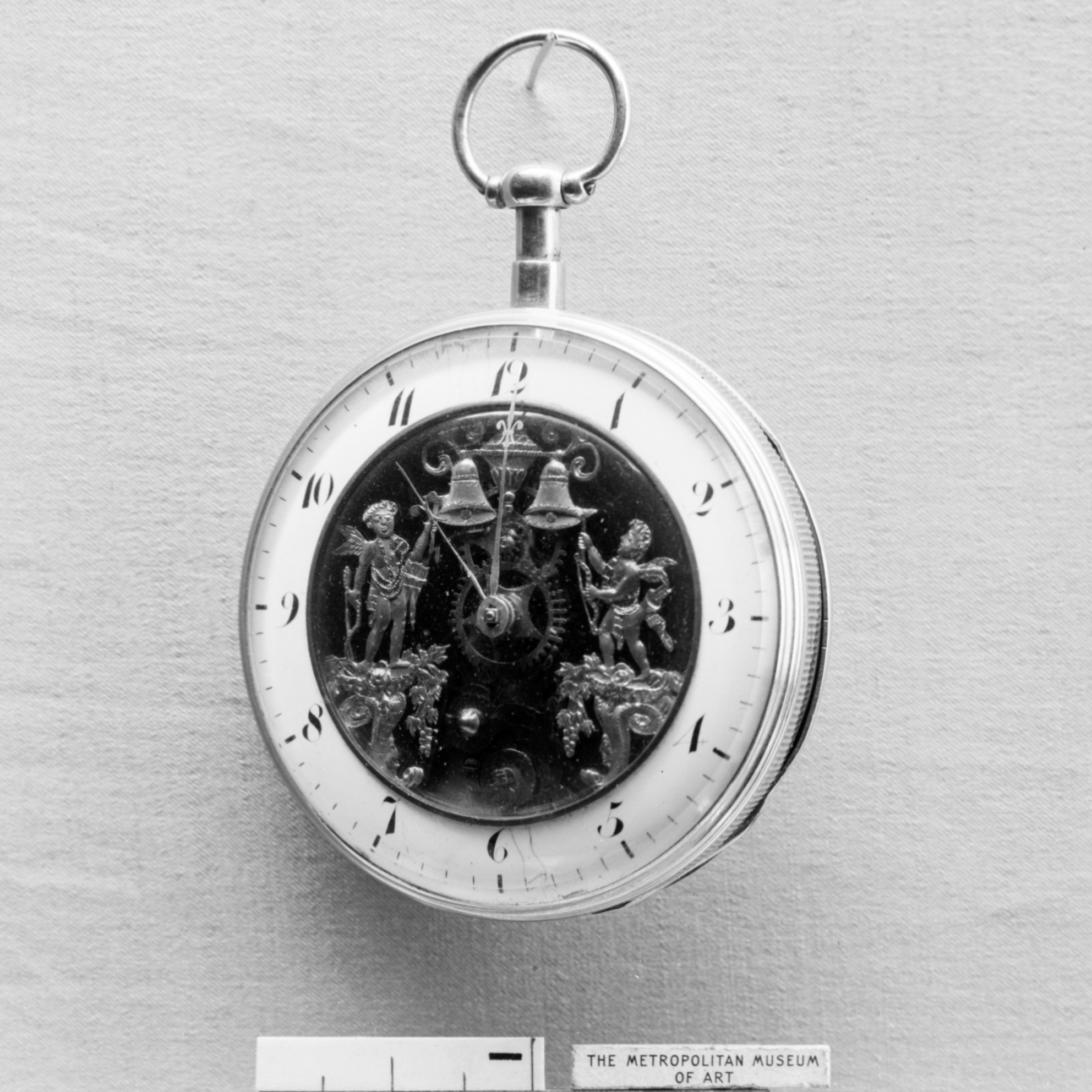
The museum’s classification places the watch within the tradition of mechanical repetition. The distinction between quarter and minute repetition lies in the resolution of the striking mechanism: the former communicates hours and elapsed quarters, while the latter additionally resolves the residual minutes. The published catalogue does not identify which subdivision this movement employs.
The fascination lies in the coexistence of decorative art and engineering. A portable watch of this period might be encountered as a precious object before its mechanical capabilities become apparent. The case is the visible work. The complication is the concealed work. In a repeater, that hidden architecture announces itself through sound.
Collecting a complication, not just a reference
Owning a repeater presents considerations that do not arise in the same way with an ordinary time-only watch. The condition of its timekeeping train and its striking train both matter. A movement that keeps time can still have a faulty or incomplete repeating mechanism. An attractive dial and an immaculate case are not enough to establish mechanical health.
Before considering an acquisition, ask for an independent assessment from a specialist familiar with the particular complication. Establish whether the striking mechanism functions throughout its range, whether any parts are replacements, whether the watch has been altered and whether appropriate repair expertise is available. Ask for documented service history where it exists, and for a realistic estimate of potential work rather than assuming ordinary watch-service costs.
Do not activate an unfamiliar antique mechanism forcefully or manipulate it while the hands are being adjusted unless the relevant maker or qualified specialist confirms the correct procedure. Unknown mechanical condition and inappropriate operation can create expensive damage. The safest way to hear a rare watch is often to ask its custodian to demonstrate it.
Provenance and originality also require precision. A maker's archive extract may establish specific historical information without authenticating every component currently fitted to a watch. A seller's condition opinion, a historical certificate and a current mechanical examination serve different purposes. A responsible collector keeps those categories of evidence distinct.
The market: three documented results
At Phillips’ Geneva Decade One auction on November 8–9, 2025, a 1907 Patek Philippe 18-karat yellow-gold minute repeater (lot 20) realized approximately $113,700. A 1905 yellow-gold open-face pocket watch integrating a minute repeater, perpetual calendar, moonphase display and single-button chronograph (lot 38) realized approximately $158,000. Both prices include the buyer’s premium.
On May 9, 2026, at Phillips’ Geneva Watch Auction XXIII, a 1918 Patek Philippe yellow-gold pocket watch with the same principal complication architecture (lot 25) realized approximately $245,100. The catalog records a 54.5 mm case, enamel dial, archival documentation and a first appearance at auction.
The distinction between mechanical complexity and collectible significance is particularly evident in these results. The 1907 minute repeater, despite its comparatively restrained complication architecture, achieved a hammer price 2.4 times its upper estimate. Its documented 1939 case and dial upgrade illustrates an important distinction between a recorded period modification and undocumented subsequent intervention.
The two grand complications introduce a different valuation consideration. The 1905 watch reached its upper estimate at hammer, while the 1918 example exceeded its high estimate by 25%. Their integration of calendar, timing and chiming mechanisms demonstrates considerable mechanical sophistication, yet their auction results diverged substantially. Original documentation, preservation of the enamel dial, provenance, scarcity of surviving configurations and freshness to the auction market all warrant individual examination. A complication count, in isolation, is an inadequate basis for establishing comparative value.
The Collector's Archive
A final thought
A repeater invites a different kind of attention. Rather than scanning a dial, we wait for a sequence to finish. The machine asks us to listen before we understand. In a world of instant digital time, that small delay reveals why mechanical objects can remain compelling long after their original utilitarian advantages have disappeared.
Would you prefer a watch that displays the time beautifully, or one that makes the time audible?
Sources and editorial notes
Patek Philippe Museum, Repeating, 1839–1926: https://static.patek.com/pdf/others/Patek_Philippe_Museum_Catalog_Preview_Volume_I.pdf
Patek Philippe, Chiming Watches: https://www.patek.com/en/manufacture/quality-and-fine-workmanship/the-patek-philippe-sound
Horology Atlas, Minute repeater mechanism: https://atlas.watchmuseum.org/encyclopedia/minute-repeater
The Metropolitan Museum of Art, Repeater pocket watch, 89.2.77: https://www.metmuseum.org/art/collection/search/187191
Phillips, Decade One 2025 lot 20: https://www.phillips.com/detail/patek-philippe/223001
Phillips, Decade One 2025 lot 38: https://www.phillips.com/detail/patek-philippe/223000
Phillips, published premium-inclusive sale results: https://www.dist.phillips.com/content/web/auction-results/auctionResultsFile_CH080425.pdf
Phillips, Geneva Watch Auction XXIII lot 25: https://www.phillips.com/detail/patek-philippe/223003
Phillips, Geneva Watch Auction XXIII, published results: https://dist.phillips.com/content/web/auction-results/auctionResultsFile_CH080226.pdf
Currency methodology: published premium-inclusive CHF 91,440, CHF 127,000 and CHF 190,500 divided by the Federal Reserve H.10 rates of 0.8040 CHF/USD (November 7, 2025) and 0.7773 CHF/USD (May 8, 2026), respectively; rounded to the nearest $100. Sources: https://www.federalreserve.gov/releases/h10/20251110/ and https://www.federalreserve.gov/releases/h10/20260511/. Hammer figures: CHF 72,000, CHF 100,000 and CHF 150,000, derived from the published 27% buyer’s premium applicable to each lot. Estimates exclude premium.